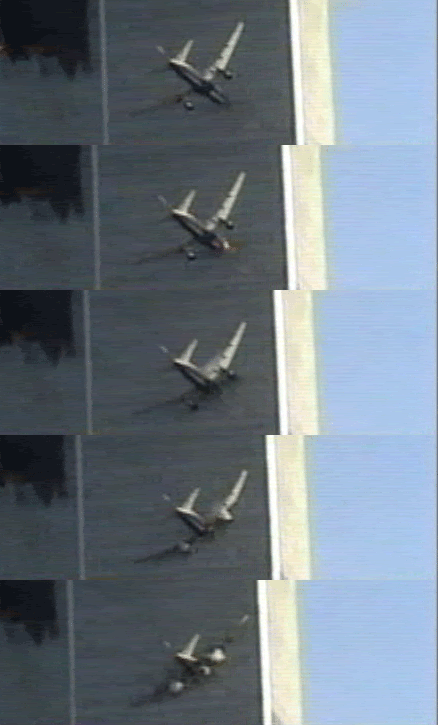
9/11 video fakery has been proven. The videos showing a plane look fake because they are fake. So cheesy are they, that composi-traitors like Evan Fairbanks felt compelled to appear on television and declare that a commercial airliner “disappeared like a bad special effect”. News perp Peter Jennings memed, “It’s like a graphic artist, isn’t it?” Yes, indeed.
Live Video Compositing Rules Out Flying Objects
To be specific, the 9/11 airplane videos are video composites. Each has had a flying airplane image inserted into what is otherwise legitimate footage. Most of these approximately 30 videos came after the fact, but 2 of them were shown live. Focusing on the live airplane videos, and understanding compositing technology, we can rule out a number of scenarios which have been proposed to explain the damage that occurred to the twin towers.
In fact, accepting video fakery on the live shots, we can rule out any flying object as having caused the airplane-shaped holes. Inserting an airplane image into a live shot is doable, under certain very specific circumstances, as I explain in the Theory of Live 9/11 Composites. If there is really an empty sky, an airplane image can be made to appear to fly right across. If there is high contrast between a nice, straight, dark tower, and a bright sky, the airplane can be made to disappear behind the edge.
However, covering up and/or erasing a real flying object on video is a different matter altogether, whether the object is a missile, a UAV, a Global Hawk, an A-3 Skywarrior, or anything else. A flying object could literally be covered up with an overlaid airplane image, provided the airplane is bigger, and provided the motion can be matched.
Matching the motion of a video object in real time involves real-time motion tracking. Motion tracking software was in its infancy in 2001, and even today, in 2008, an incoming small flying object could not be reliably tracked in real-time.
Motion tracking works by identifying by a pattern of pixels on a particular frame. The software then looks for a similar pattern on each subsequent frame, and keeps track of the change in position. The identifying pattern must be selected first, on a frozen frame. Only then can the software attempt to track. For an incoming object like a missile, there is simply no time to select what is being tracked.
Even if a selection could somehow be made, motion tracking is notoriously finicky. Any small error in tracking would give the overlaid airplane image an unnatural motion. With current technology, there is no possible way to reliably track a flying object live in real-time.
So the perpe-traitors might have considered attacking the twin towers with a missile and replacing it on video with images of a 767. For non-live video, this is doable. But factoring in the necessity of showing the television audience live footage of an airplane, this entire scenario can be ruled out as technically impossible.
To be specific, the 9/11 airplane videos are video composites. Each has had a flying airplane image inserted into what is otherwise legitimate footage. Most of these approximately 30 videos came after the fact, but 2 of them were shown live. Focusing on the live airplane videos, and understanding compositing technology, we can rule out a number of scenarios which have been proposed to explain the damage that occurred to the twin towers.
In fact, accepting video fakery on the live shots, we can rule out any flying object as having caused the airplane-shaped holes. Inserting an airplane image into a live shot is doable, under certain very specific circumstances, as I explain in the Theory of Live 9/11 Composites. If there is really an empty sky, an airplane image can be made to appear to fly right across. If there is high contrast between a nice, straight, dark tower, and a bright sky, the airplane can be made to disappear behind the edge.
However, covering up and/or erasing a real flying object on video is a different matter altogether, whether the object is a missile, a UAV, a Global Hawk, an A-3 Skywarrior, or anything else. A flying object could literally be covered up with an overlaid airplane image, provided the airplane is bigger, and provided the motion can be matched.
Matching the motion of a video object in real time involves real-time motion tracking. Motion tracking software was in its infancy in 2001, and even today, in 2008, an incoming small flying object could not be reliably tracked in real-time.
Motion tracking works by identifying by a pattern of pixels on a particular frame. The software then looks for a similar pattern on each subsequent frame, and keeps track of the change in position. The identifying pattern must be selected first, on a frozen frame. Only then can the software attempt to track. For an incoming object like a missile, there is simply no time to select what is being tracked.
Even if a selection could somehow be made, motion tracking is notoriously finicky. Any small error in tracking would give the overlaid airplane image an unnatural motion. With current technology, there is no possible way to reliably track a flying object live in real-time.
So the perpe-traitors might have considered attacking the twin towers with a missile and replacing it on video with images of a 767. For non-live video, this is doable. But factoring in the necessity of showing the television audience live footage of an airplane, this entire scenario can be ruled out as technically impossible.
They Wouldn't Use Missiles Anyway
In fact, even ignoring the problems with live motion tracking, I think we can rule out flying objects with logic. The same reasoning that allowed Gerard Holmgren to rule out the use of real planes in his 2006 article, may be extended to rule out the use of all flying objects.
Accepting the general notion of 9/11 as an inside job, and that the perpe-traitors wanted to sell a story about suicidal Musilm hijackers using airplanes to cause catastrophic damage to the twin towers, Holmgren methodically goes through options. There are simply too many problems with using real airplanes.
Real pilots could never be trusted to actually commit suicide, so any real-plane scenario must involve remote control guidance. If the real flights AA11 and UA175 were electronically hijacked, the pilots and flight attendants would be on the radio, and the air-phones, screaming “Help! We’ve been electronically hijacked!”. Even if those systems could be sabotaged, at low altitude, personal cell phones would work.
Perhaps the real passenger flights could be landed somewhere, and switched with military 767s, flown by remote guidance. Can a 767 really be reliably targeted with accuracy down to 1 foot? I doubt it, and that is what is needed in this situation. If the “collapse” begins obviously below where the plane hit, how would that be explained away?
Worse, what if the plane partially misses the tower? If even a wing tip were to break off and land on the street somewhere, it could be found and photographed by the wrong person. A passenger aircraft has over 1 million serial number parts. If the serial number on that military plane doesn’t match the records for UA175, how is that explained away?
As difficult as those problems are to solve, the fundamental unsolvable problem with real airplanes is physics. The people must believe that there is extensive damage to the core structure of each tower. This requires what Killtown calls “Guaranteed Penetration”, an apt phrase. And to carry off the “collapse” hoax, the demolitions must begin at the location of the airplane holes. Therefore the airplanes must appear to penetrate and completely enter the tower, at very precise locations. There is no way the engineers could guarantee that.
An aluminum passenger jet simply will not enter a steel and concrete tower . The tower is much, much stronger. The twin towers were specifically designed to withstand the crash of a commercial jetliner. A real plane would mostly crash up against the side of the tower, exploding and sending serial number wreckage down to the street below. Such an occurrence would do very little damage to the building, but would obliterate the official story.
Holmgren knew enough about physics and airplanes to reason that far, and concluded that it must have been a missile strike. Missiles can be precision targeted, at least more so than airplanes. And missiles are good for blowing large holes in strong structures. But he didn’t know enough about video technology to rule out live motion tracking, as I have done.
And there are other problems with missiles. Missiles blow the hell out of things. How could a missile be controlled to create a plane-shaped hole? Could pre-planted explosives in the building help determine the shape of the hole? Yes, but then why not just use the pre-planted explosives by themselves? Why complicate things with a missile?
What About Amateur Photographers?
Further, even if an incoming missile could be replaced on live TV with an airplane image, what about amateur photographers? With anything flying towards the twin towers, chances are very good that many people would shoot photos and videos. This becomes a sticky problem. On the other hand, if there is no flying object of any kind, the chances of an incriminating amateur video drop drastically. People shoot pictures of flying things. But how does someone shoot a picture of nothing?
It’s possible that someone would inadvertently shoot video of the tower exploding. But there would be far, far less of those to deal with, than there would with any sort of flying object to attract attention.
The strategy for dealing with amateur photographers is first to confiscate. We know for certain that agents were in position around the towers confiscating cameras and deleting digital files. If incriminating footage slipped through the Gestapo, the next strategy would be to co-opt. “What We Saw” by “Bob & Bri” is very dramatic home video shot from an apartment just northwest of the towers. They began shooting shortly after the first “airplane strike”. They captured both of the demolitions. But the second “airplane strike”was evidently edited out.
If confiscating and co-opting fail, and someone did decide to go public with footage of no plane, the perpe-traitors would simply claim that this footage was faked. They would claim that the photographer removed the airplane from the footage. They would seize the no-plane footage, composite an airplane into it, and claim that was the original. A computer with editing software and files would be planted as evidence, and the photographer would be charged with being a terrorist. He would be sent to prison, and silenced.
The hole in the north tower shows a few perimeter columns which are bent inward. This has been cited as proof that the tower was hit from outside with some sort of flying object. But this is not necessarily true. A sagging floor will create an inward pull between the core and perimeter. We see this trick occurring shortly before the main demolitions, where the outer wall sections are bent significantly inward, at places where nothing is alleged to have hit from the outside.
Can the perpe-traitors really control the amateur video? If you are inclined to think not, then answer this: Where is the video of the hole forming in the south tower? The best video to show that would be CNN Ghostplane. Ghostplane is edited. We see the airplane image enter the tower, we see the wings pass through the wall without creating the hole. We see the white explosions come out of the wall, then we see the orange and black fireball coming from deep within the building.
Ghostplane is supposedly amateur footage shot by Michael Hezarkhani. Who edited it? What did the missing footage show? What format was the original? Where is that tape? Why does Hezarkhani say that he is not allowed to speak about his video, on advice of his lawyer?
And what about Chopper 5? Shouldn’t there be thousands, or at least hundreds of different copies around, recorded by hundreds of different people on their home VCR decks? Where are they? There are only two (2) versions of Chopper 5 – the west coast and the east coast. The two are quite different from one another, and are suspect. Where is an actual original recording off of the television?
I have advertised and sent out numerous requests for original television recordings from 9/11. When it comes to Chopper 5, they simply do not exist. WNYW FOX 5 TV in New York has refused all requests to license the footage.
Further, even if an incoming missile could be replaced on live TV with an airplane image, what about amateur photographers? With anything flying towards the twin towers, chances are very good that many people would shoot photos and videos. This becomes a sticky problem. On the other hand, if there is no flying object of any kind, the chances of an incriminating amateur video drop drastically. People shoot pictures of flying things. But how does someone shoot a picture of nothing?
It’s possible that someone would inadvertently shoot video of the tower exploding. But there would be far, far less of those to deal with, than there would with any sort of flying object to attract attention.
The strategy for dealing with amateur photographers is first to confiscate. We know for certain that agents were in position around the towers confiscating cameras and deleting digital files. If incriminating footage slipped through the Gestapo, the next strategy would be to co-opt. “What We Saw” by “Bob & Bri” is very dramatic home video shot from an apartment just northwest of the towers. They began shooting shortly after the first “airplane strike”. They captured both of the demolitions. But the second “airplane strike”was evidently edited out.
If confiscating and co-opting fail, and someone did decide to go public with footage of no plane, the perpe-traitors would simply claim that this footage was faked. They would claim that the photographer removed the airplane from the footage. They would seize the no-plane footage, composite an airplane into it, and claim that was the original. A computer with editing software and files would be planted as evidence, and the photographer would be charged with being a terrorist. He would be sent to prison, and silenced.
The hole in the north tower shows a few perimeter columns which are bent inward. This has been cited as proof that the tower was hit from outside with some sort of flying object. But this is not necessarily true. A sagging floor will create an inward pull between the core and perimeter. We see this trick occurring shortly before the main demolitions, where the outer wall sections are bent significantly inward, at places where nothing is alleged to have hit from the outside.
Can the perpe-traitors really control the amateur video? If you are inclined to think not, then answer this: Where is the video of the hole forming in the south tower? The best video to show that would be CNN Ghostplane. Ghostplane is edited. We see the airplane image enter the tower, we see the wings pass through the wall without creating the hole. We see the white explosions come out of the wall, then we see the orange and black fireball coming from deep within the building.
Ghostplane is supposedly amateur footage shot by Michael Hezarkhani. Who edited it? What did the missing footage show? What format was the original? Where is that tape? Why does Hezarkhani say that he is not allowed to speak about his video, on advice of his lawyer?
And what about Chopper 5? Shouldn’t there be thousands, or at least hundreds of different copies around, recorded by hundreds of different people on their home VCR decks? Where are they? There are only two (2) versions of Chopper 5 – the west coast and the east coast. The two are quite different from one another, and are suspect. Where is an actual original recording off of the television?
I have advertised and sent out numerous requests for original television recordings from 9/11. When it comes to Chopper 5, they simply do not exist. WNYW FOX 5 TV in New York has refused all requests to license the footage.
Gelitin
The airplane–shaped holes were blown with pre-planted explosives. I strongly suspect that “Gelitin” were the crew in charge of setting up the explosives in the North Tower. Who are Gelitin?
Get this: According to an August 2001 New York Times article "Balcony Scene (or unseen) Atop the World", a group of “artists” calling themselves “Gelitin” took over and occupied the 91st floor of the North prior to 9/11. In what was dubbed a work of performance art entitled "The B-Thing", they built a structural balcony and were photographed out on it.

They made drawings that included the layout of the core columns, and the perimeter columns. A surviving drawing is made showing precisely the correct number of 240 perimeter columns.

“AA11” allegedly struck at the 92nd floor of the North tower. How suspicious is it that “Gelatin” were holed up at floor 91, and outside on the perimeter doing who knows what? Does anyone believe these were performance artists?
The airplane–shaped holes were blown with pre-planted explosives. I strongly suspect that “Gelitin” were the crew in charge of setting up the explosives in the North Tower. Who are Gelitin?
Get this: According to an August 2001 New York Times article "Balcony Scene (or unseen) Atop the World", a group of “artists” calling themselves “Gelitin” took over and occupied the 91st floor of the North prior to 9/11. In what was dubbed a work of performance art entitled "The B-Thing", they built a structural balcony and were photographed out on it.
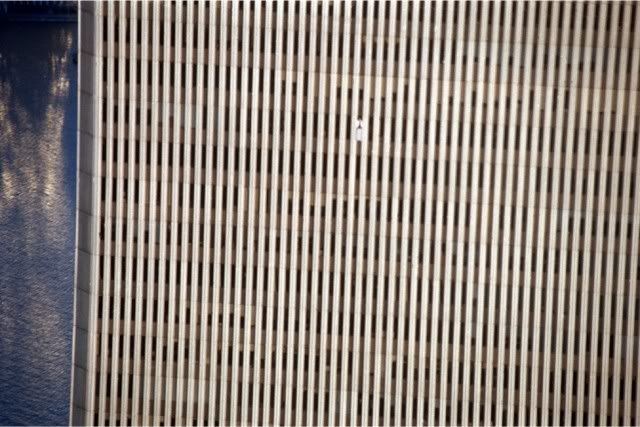
They made drawings that included the layout of the core columns, and the perimeter columns. A surviving drawing is made showing precisely the correct number of 240 perimeter columns.

“AA11” allegedly struck at the 92nd floor of the North tower. How suspicious is it that “Gelatin” were holed up at floor 91, and outside on the perimeter doing who knows what? Does anyone believe these were performance artists?